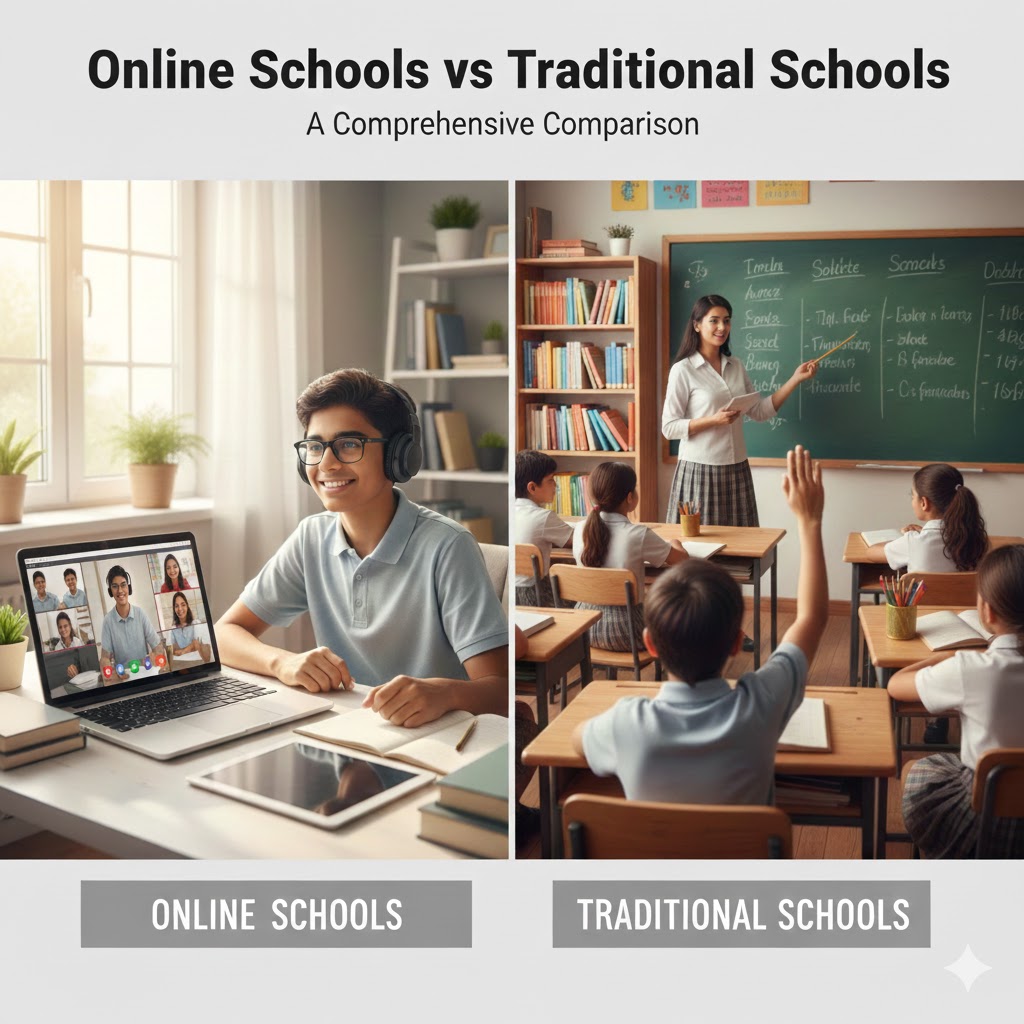
The old notion that learning only takes place in classrooms is gradually fading. Today, students in India can attend either traditional schools with a fixed timetable and face-to-face teaching or flexible online schools that deliver lessons at home. The decision affects learning style, academic performance, and overall student well-being.
As digital education benefits increase, parents are now deciding between online vs traditional schools. According to KPMG India, the online learning market in India is projected to be worth $1.96 billion by 2021, which is a clear indication of how fast digital education is rising.
This blog compares the two systems in terms of differences, pros, and cons and also highlights the trends changing the Indian education system.
What Are Online Schools and Why Are They Growing?
Online schools offer education through the internet. Students are able to attend live lectures and watch recorded sessions. They also complete assignments online and participate in online forums.
- A 2022 Statista survey found that over 60% of Indian students have used online learning platforms at least once.
- Online education platforms in India offer organised curricula and interactive tools, including educational video content for online learning platforms
One of the most appealing aspects is the flexibility. Students can take classes at any time or revisit lessons and adjust their pace according to their level of understanding. Online schools also give access to world-class content, which allows students to broaden their understanding and build capabilities that may not be included in local curricula.
Research conducted by TalentLMS indicates that students who take online classes retain an average of 20-30% more content than students in traditional classrooms.
How Traditional Schools Shape Learning
Traditional schools are still a major part of the educational system in India. They offer fixed schedules, direct guidance from teachers, and various social and extracurricular activities.
- As per the Ministry of Education India, more than 75% of students take up at least one extracurricular activity every week, thus developing their leadership and teamwork skills.
- A large classroom can sometimes limit individual attention, and can drain learning efficiency for students who travel over an hour daily
Despite these issues, the traditional schools excel at instilling disciplines, skills for social interaction, and mentorship, which are hard to replicate online. Kids also gain from collaboration, solving problems, debates, sports, and other cultural activities that help shape the holistic development of children.
Online vs Traditional School: Key Differences
When comparing online vs traditional school, several distinctions become clear:
- Flexibility: Online schools allow learning anytime, anywhere; traditional schools follow fixed schedules.
- Personalisation: Digital learning platforms adapt to the student’s pace; conventional classrooms teach to the entire group.
- Social Interaction: Traditional classrooms provide daily peer engagement; online schools often rely on forums and virtual discussions.
- Cost: Online education can reduce expenses by 20–30% on transport, uniforms, and infrastructure.
| Feature | Online Schools | Traditional Schools |
| Schedule | Flexible, self-paced | Fixed timetable |
| Learning Style | Interactive videos, quizzes | Classroom lectures, labs |
| Interaction | Virtual chats, forums | Face-to-face group activities |
| Cost | 20–30% lower | Transport, uniforms, infrastructure |
| Accessibility | Anywhere with internet | Limited to the school location |
Digital Education Benefits for Students
Digital education benefits extend beyond convenience. They can positively affect the learning outcomes, engagement, and motivation.
- Students learning at their own pace can spend more time on difficult subjects.
- Interactive quizzes and gamified content make learning enjoyable.
- The availability of worldwide resources allows students to see various perspectives.
- Adaptive tools improve student performance, with struggling students seeing 15 to 25% improvement
AAS Vidyalaya builds this approach by combining education curricula with interactive modules to make learning both engaging and effective.
Conventional Schooling Comparison: Strengths & Weaknesses
Conventional schooling comparison helps acknowledge that traditional schools still matter to many students who cannot afford online schools
Strengths:
- Organised routine and discipline
- Peer interaction and teamwork
- Face-to-face mentorship and guidance from teachers
- Participation in cultural, sports, and social activities
Weaknesses:
- Fixed learning pace
- Limited individual attention in large classrooms
- Travelling fatigue affects focus
UNESCO reports show that children perform 10–15% better in traditional classrooms in collaborative tasks compared to fully online learners, highlighting the importance of social interaction with real students.
Trends in India’s education system
The education system in India is rapidly changing. NEP 2020 emphasises digital integration, multilingual education, multilingual learning, as well as individualized teaching strategies.
- Urban internet penetration is at 85%, while rural areas are at 55% (TRAI 2023), which allows more students to attend online schools.
- Hybrid learning strategies that blend classes with online platforms are becoming increasingly popular.
- Platforms like e learning platforms in India offer interactive lessons, assessments, and engaging modules, supporting both traditional and online learning.
Online vs traditional school choosing the right option for your child
When choosing between online vs traditional school, consider:
- Learning style: Independent vs collaborative learners
- Social needs: Student interaction and extracurricular activities
- Family schedule: Commute, flexibility, and time management
- Technology access: Devices, stable internet, and digital literacy
Many parents now prefer a hybrid approach, using traditional schooling for social and extracurricular development and online platforms for personalized learning and revision.
What is the future learning
The future of education is likely to be hybrid. Schools are increasingly incorporating digital technology into their curriculum, resulting in an environment that is flexible and able to take advantage of the digital education benefits without sacrificing the advantages of traditional education.
- According to a 2023 EY report more than 40 percent of Indian schools are testing mixed learning methods.
- Students benefit from personalized learning pathways with interactive content and classes that are collaborative, allowing for an enlightened and balanced approach to education.
AAS Vidyalaya allows hybrid learning to ensure students can access high-quality content, while also benefiting from traditional teacher guidance in the classroom.
Conclusion
Both online and traditional schools have their own sets of advantages. Traditional schools ensure social development, discipline, and collaborative learning, while online schools offer flexibility, personalized attention, and several demonstrated digital education benefits.
Hybrid schooling models are supported by the evolving education system in India, which allows students to have the best of both worlds. Whether online or traditional school is better depends on your child's learning style, social needs, and family priorities.
Discover AAS Vidyalaya, which merges structured learning with digital education benefits to provide an enjoyable, flexible, and future-ready educational experience to your child.
Frequently Asked Questions (FAQs)
Q1: What is the main difference between online vs traditional school?
Online schools provide flexible digital learning, while traditional schools offer structured face-to-face interaction and social exposure.
Q2: What digital education benefits are available for Indian students?
Students gain personalised learning, better retention (20–30%), interactive content, and flexibility, improving focus and outcomes.
Q3: How does conventional schooling comparison show advantages?
Traditional schools strengthen teamwork, discipline, social skills, and problem-solving, which help long-term development.
Q4: Are there reliable online platforms for students in India?
Yes. Online education platforms in India provide structured lessons, assessments, and educational video content for online learning platforms