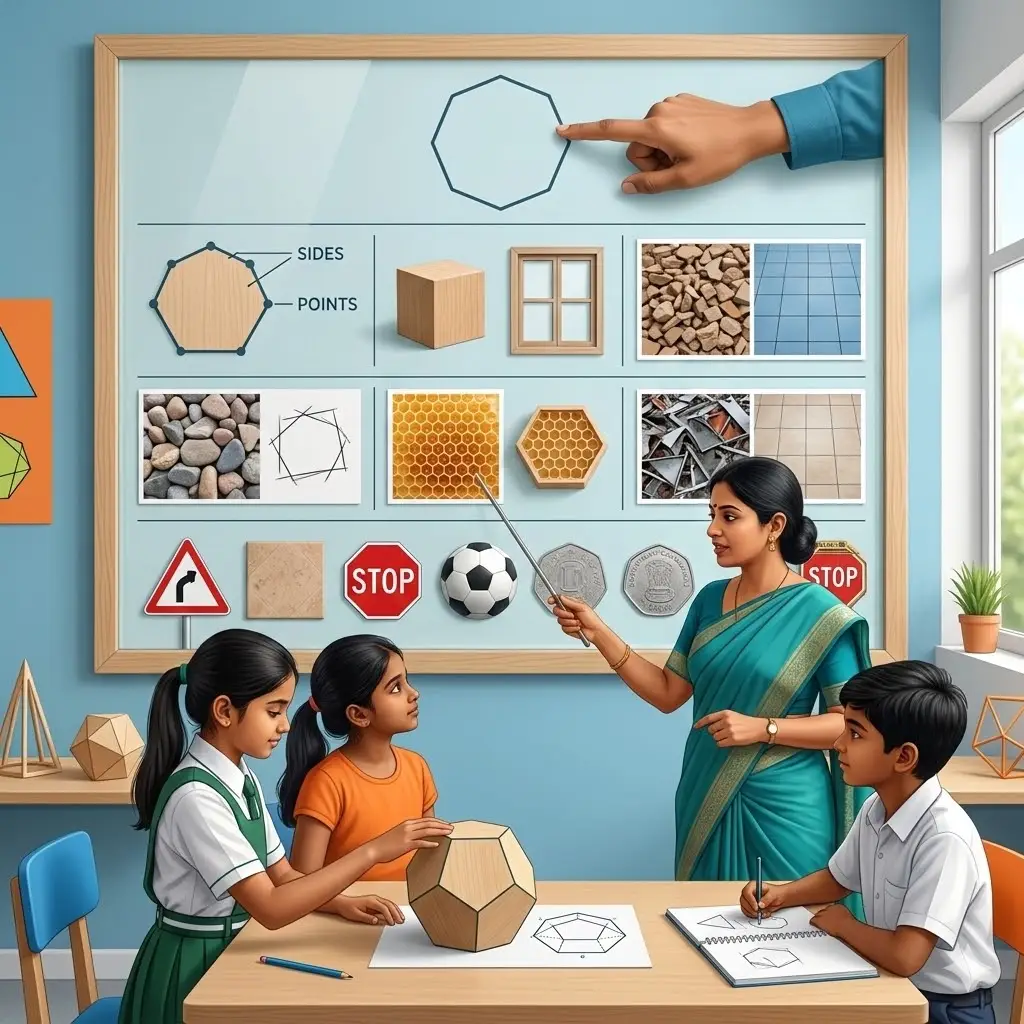
Most kids look at a geometry book and see a bunch of random shapes that seem to have nothing to do with real life. But if you look at the floor tiles in your house or the stop sign on the road, you are actually staring at geometry in action. Understanding what polygons are is the first step toward realizing that the whole world is built on straight lines and corners. It is not just about memorizing names for a school test but about seeing the patterns that make everything from bridges to honeycombs stay in place. Whether you are a student trying to pass your exams or a parent helping with homework, knowing the polygon meaning with examples makes the whole subject feel less like a chore and more like a logic puzzle. Once you get the hang of the basic rules, you will start seeing these shapes everywhere you go.
The basic rules of the shape game
Before you can dive into the different names, you need to understand the polygon definition in maths, which is actually quite simple. A shape only qualifies if it follows three strict rules: it must be flat, it must be closed, and it must have only straight sides. If a shape has a curve, like a circle, or an open end, like a letter U, it simply does not count in this category.
- All polygons in mathematics explained simply are just closed loops made of straight line segments that do not intersect.
- A shape must have at least three sides to be closed because you cannot make a loop with just two straight lines.
- The points where the lines meet are called vertices, and every side must be a straight line with no bends.
- Platforms like AAS Vidyalaya help students visualize these rules through simple videos that make the meaning of polygons with examples much clearer.
Grouping them by their personality
When we classify polygons, we usually look at how "perfect" or "messy" the shape appears. The most common way to group them is to check whether all their sides and angles are the same, or if they are just random lengths joined together. This is where the types of polygons start to get interesting: a square and a random four-sided piece of paper are both in the same family,y but look totally different.
- Regular versions have sides and interior angles that are all the same, like a square or an equilateral triangle.
- Irregular versions are those in which the sides are different lengths and the angles are not equal, unlike a rectangle or a kite.
- You also have convex shapes, where all corners point outward, and concave ones, where at least one corner points inward toward the middle.
- Learning about polygons and their properties becomes much easier when you use e learning platforms in india to see how these shapes move and change.
Names based on the number of sides
The easiest way to answer whata polygon is in geometry is often by just counting the sides and giving it a name. Most of the names we use come from old Greek words where "poly" means many and "gon" means angle. From a simple three-sided triangle to a complex ten-sided decagon, each one has a specific role in how objects are built.
- A triangle has three sides and is the strongest shape in nature, which is why you see it in big towers and bridges.
- Quadrilaterals have four sides and include familiar shapes such as squares, rectangles, and diamonds that we see in books and on screens.
- Pentagons have five sides and hexagons have six, which you can see in the structure of a honeycomb made by bees.
- The classification of polygons continues with heptagons (7 sides) and octagons (8 sides), just like a traffic stop sign.
The math secrets behind the angles
If you want to master polygons and their properties, you need to know a few "cheat codes" or formulas that work every single time. One of the coolest things is that no matter how many sides a shape has,s there is a fixed rule for how much the total angles inside will add up to. This part of polygons in mathematics explains how engineers and architects design buildings that don't fall.
- The sum of the interior angles of any shape can be found by taking the number of sides, subtracting two, and multiplying by 180 degrees.
- For any convex shape, the exterior angles always add up to exactly 360 degrees, whether it has three sides or a hundred.
- The number of diagonals you can draw inside a shape also follows a fixed pattern based on how many vertices it has.
- Leading e learning platforms in India, like AAS Vidyalay, show you how to use these formulas on real-life objects so you never forget them.
Conclusion
So, what is a polygon in geometry at the end of the day? It is the basic building block of almost everything we see around us. From the screen you are reading this on to the tiles on your floor, knowing the definition of a polygon in maths helps you understand the world better. By practicing the different types of polygons and seeing how they work in real life, you take the fear out of math. Geometry is not just about lines on a page; it is the language of design and nature. Once you understand what polygons are,e you start to see that math is actually a tool for creating things. Keep exploring these shapes, and you will soon find that geometry is one of the most practical skills you can ever learn.
Frequently Asked Questions
Q: Is a circle a polygon?
Answer: No, because a circle has a curved boundary,y and the polygon definition in maths strictly says all sides must be straight lines.
Q: What is the smallest possible polygon?
Answer: The smallest one is a triangle because you need at least three straight sides to join them together and form a closed shape.
Q: What are some real-life examples of polygons?
Answer: Common examples include a rectangular door, a triangular slice of pizza, a square floor tile, and an octagonal stop sign.
Q: Can a polygon have crossing lines?
Answer: In basic geometry, most types of polygons we study are simple,e meaning the lines do not cross each other, though complex versions do exist.