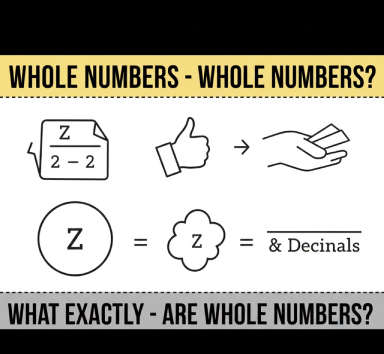
Many students feel comfortable with their numbers, but they pause when asked a question: What numbers are whole numbers? This is a common issue in math classes for children, as well as competitive exams and even everyday solving.
It may sound like a technical concept, but it's linked to our daily lives. This blog will explain whole numbers in plain English, and clarify common misconceptions, and explain how understanding these concepts will help you build a strong mathematical foundation. In the end, you'll be able to recognize complete numbers in a flash and can be able to use them confidently.
What Numbers Are Whole Numbers in Simple Words?
Whole numbers are the numbers that are used to count things completely. They are composed of the number 0 as well as all positive counting numbers, such as 1, 2, 3, 4, etc. Simply speaking, if you count objects without breaking them down into pieces, using whole numbers.
Mathematically, the whole number looks like this:
0, 1, 2, 3, 4, 5...
They do not include fractions such as 1/2, decimals similar to 2.5, or negative values such as 3. This definition is consistent with the global curriculum for schools, which includes NCERT and international math standards.
When students inquire about what numbers are real numbers, the most straightforward answer is that numbers that start from zero and are complete
Why Zero Matters When We Ask What Numbers Are Whole Numbers
Zero is a crucial element in modern math. Numerology systems of the past did not always contain zero; its formal recognition changed the way of thinking and calculation. Zero is now generally accepted as a total number.
Zero represents:
- There are no items in a group.
- A zero balance in the banking system.
- Attendance count is not a factor when no one is present
Education frameworks across the globe contain zero in whole numbers since it is the whole number and not a fraction or loss. The removal of zero could break the consistency of math operations, such as subtraction or the place value system.
When you are trying to figure out what numbers are whole numbers, remember that zero is the point of beginning.
What numbers are whole numbers according to mathematics?
In maths, whole numbers make up a basic number set that is written as:
W = {0, 1, 2, 3, …}
This definition is consistent across all academic systems. In accordance with NCERT math textbooks as well as International education bodies, full numbers comprise non-negative integers, without decimal or fractional parts.
This consistency enables students worldwide to change between educational boards without confusion. No matter if a student is in India, the UK, or the US, the answer to what numbers are whole numbers remains the same.
Where do whole numbers fit in the number system?
Understanding number systems becomes easier when you see where whole numbers sit.
Natural numbers start at 1:1, 2, 3, 4...
Whole numbers begin at zero:
0, 1, 2, 3...
This distinction can be confusing. Natural numbers are used to count objects, and whole numbers contain the notion"none. "none."
Whole Numbers vs Integers
Integers can be negative in value:
..., -3, -2, -1, 0, 1, 2...
Total numbers are never below zero. They are simple, practical, positive, and uplifting. This clarity helps students avoid making mistakes during the beginning of math learning.
Real-life examples that show what numbers are whole numbers
The whole number of numbers are constantly appearing throughout the day, usually without even a hint.
Examples include:
- Students in a class
- Pages of the book
- Steps are counted in an app for fitness
- Goals scored during a game
- Items are added to an online shopping cart
There is no way to possess 2.3 chairs or notebooks with a -5. These circumstances require complete numbers. Practical logic can explain whole numbers more effectively than formulas.
Why fractions and decimals are not whole numbers
Fractions and decimals are the portions of a total. Although they are useful but they are not regarded as complete numbers.
For instance:
- 1/2 pizza slice
- Rs2.75 balance
- 3.6 kilometers
These numbers are a result of division. Whole numbers are always whole units, not pieces. Learning to recognize this distinction can help students avoid exam mistakes and confusion about concepts.
Why learning what numbers are whole numbers is important for students
Whole numbers are the base of math. Every advanced subject builds on them.
They're in support of:
- Subtraction and addition fundamentals
- Multiplication tables
- Logical thinking
- Sorting and counting data
Research released by the National Council of Educational Research and Training is strong evidence of number sense as an important indicator of success in math
The online education system is now strengthening the foundation of this. A variety of E-learning platforms in India employ interactive tools, visual aids, and step-by-step instructions to make number concepts easier for students of all levels.
Common Mistakes Students Make About Whole Numbers
Despite their simplicity, students often make mistakes that could be avoided.
Forgetting Zero
A lot of students are unable to exclude zero due to the habit of doing so. Teachers emphasize early correction due to the fact that zero places a value on place value and counting logic.
Mixing Decimals With Whole Numbers
Values like 3.0 appear confusing. When written using decimal marks, 3.0 equals the whole number 3. An accurate explanation will avoid the confusion.
How Parents and Teachers Can Explain Whole Numbers Easily
Teaching whole numbers is best using everyday objects.
The most effective methods are:
- The counting of toys, fruits, or even books
- By using fingers and visual grouping
- You should ask "how many" instead of "how much."
Digital education also helps to improve clarity. Platforms such as AAS Vidyalaya organize lessons in a way that is logical to reinforce the basics, integrate with the school curriculum, and help students gain confidence in the beginning.
1. Is zero a whole number?
Yes, zero is a whole number. Whole numbers start from 0 and include all positive counting numbers like 1, 2, 3, and so on.
2. Are negative numbers whole numbers?
No, negative numbers are not whole numbers. Numbers like –1, –2, and –3 belong to integers, not whole numbers.
3. What are whole numbers?
Whole numbers are numbers that start from 0 and increase without including fractions, decimals, or negative numbers.
Examples: 0, 1, 2, 3, 4, 5…
4. What is the simplest definition of whole numbers?
Whole numbers are non-negative numbers without fractions or decimals, starting from zero.
5. Do whole numbers include fractions or decimals?
No, whole numbers do not include fractions (½) or decimals (2.5).
6. What is the difference between whole numbers and natural numbers?
Natural numbers usually start from 1, while whole numbers start from 0.
7. What is the smallest whole number?
The smallest whole number is 0.
8. Are whole numbers and integers the same?
No. Integers include negative numbers, zero, and positive numbers, while whole numbers include only zero and positive numbers.
9. Can whole numbers be negative?
No, whole numbers cannot be negative.
10. Why are whole numbers important?
Whole numbers are used for counting and form the basic foundation of mathematics.
Conclusion
Knowing what numbers are whole numbers reduces math anxiety and provides long-lasting clarity. Whole numbers begin at zero, include counting numbers, and are all the values that are used in everyday life. They aid in learning logic and even digital education. Once they're mastered, they can help make math more accessible and more natural.