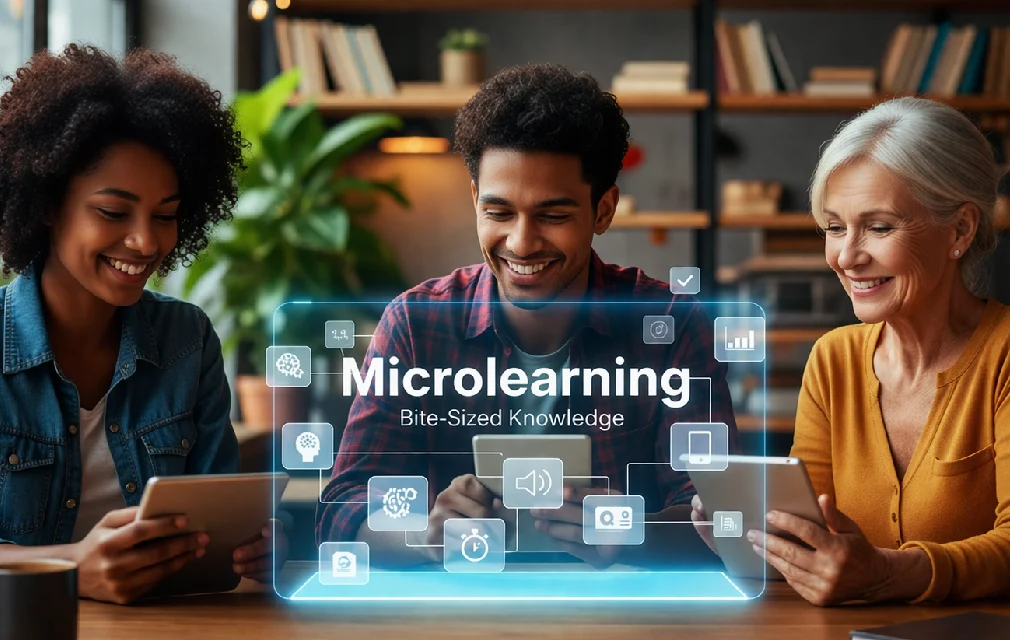
Have you ever watched a brief three-minute instructional video and then instantly discovered something that stuck in your mind? That one-minute, powerful moment is known as microlearning. A small, targeted piece of information that fits seamlessly into our daily routines. Instead of sitting through lengthy lectures or endless online courses, Microlearning allows you to learn a single concept at the same time in a straightforward, exciting way.
In this blog, we'll examine the microlearning meaning. What it does, how it operates, interesting microlearning examples, and the main advantages that make it one of the most effective methods
What does microlearning refer to?
At its simplest, microlearning means learning information in small, bite-sized units. Each lesson covers a single idea or skill and can be done within minutes. This approach prevents information overload and keeps the learners motivated.
Consider it as eating snacks instead of a full-course meal: quick, satisfying, and easy to absorb. These micro-lessons can be designed with a short video, quiz, flashcard, or infographic that reinforces one core point.
How does microlearning work in real life?
Microlearning is effective because it integrates seamlessly into everyday routines. Instead of spending large blocks of time to consume knowledge, learners engage with small, targeted pieces of information at the touch of a button
An employee, for instance, could watch a two-minute video on safety before beginning a shift. Students can review a subject with a five-minute interactive test. These mobile learning modules allow you to incorporate learning with time, which would be considered unproductive, like coffee breaks or commutes.
Today, there are a variety of online educational platforms in India, like AAS Vidyalaya. Various E-learning platforms in India make use of microlearning to make learning more accessible. Learners can study from anywhere, anytime, and without lengthy sessions.
What are some examples of microlearning people use daily?
There are numerous microlearning examples everywhere, even if we aren't aware of it. The most successful examples of microlearning are:
- Short instructional videos that show the basics of a particular step or skill
- Flashcards and quick quizzes to review
- Infographics that simplify complex concepts
- Mini-podcasts focusing on a single concept
- Push reminders and challenges sent to your mobile device
Each tool focuses on one learning goal and delivers it efficiently. The user is free of distraction, which makes it easier to retain and use what they've learned.
Why is bite-sized learning becoming so popular?
Bite-sized learning is popular because our attention spans are shrinking and time is limited. People prefer short, relevant, and focused lessons
Microlearning allows the learner to feel progress after each session, which maintains high motivation. Also, short lessons are easier to update, share, and reuse. This flexibility is a significant advantage in fast-changing industries.
This flexibility is why schools, startups, and companies are embracing short-form education as a practical way to train and upskill efficiently.
What are the key microlearning benefits for learners?
Here are a few microlearning benefits that make it the most sought-after method of learning currently:
- Faster learning: Short modules help learners complete lessons quickly.
- Improved memory: Repeated exposure to small pieces improves retention learning
- Higher engagement: Small lessons are engaging and achievable.
- Simple updates: Trainers are able to modify a module without having to rebuild an entire course.
- Mobile-friendly: It perfectly works with the mobile learning modules.
- Cost-effective: Creating micro-lessons typically costs less than long-running programs.
Each benefit complements the other, which makes microlearning a powerful model for continuous learning.
How do mobile learning modules fit into short form education?
The backbone of microlearning is mobile learning modules. They are designed to provide bite-sized learning directly to the learner's phone or tablet. Learners can engage in these modules from anywhere.
These modules make use of simple visuals, audio, and small interactions like tapping the answer or swiping through cards. BBecause the content is also accessible offline, learners can complete short lessons whenever they have time.
For instance, AAS Vidyalaya designs mobile-ready micro-modules and educational video content for online learning platforms that help students learn school subjects in shorter, smarter formats.
How is short-form education shaping the future of learning?
Short-form education is more than a trend; it's changing how information is disseminated. As attention spans decrease and work load increases, shorter periods of concentrated learning are shown to be more effective than lengthy sessions.
Organizations and educators are now using microlearning to teach technical, communication, and other soft skills. Learners love the fact that they can learn a subject, then review it, and then apply in a matter of minutes.This cycle of rapid learning and action helps build long-term mastery.
What challenges come with microlearning?
Although microlearning can be effective, it requires discipline and structure. Students may skip lessons in the absence of a clear sequence. Instructors should also make sure that each module is linked to the bigger picture.
The most important aspect is balance. Microlearning should simplify, not fragment learning. When combined with longer courses or guided programs, it can be a very effective aid to retention and participation.
Conclusion
Microlearning has transformed the way people learn in this digital age. With its short, focused lessons, it enables learners to grow without pressure and time barriers.
From workplace training to school education, microlearning has evolved into a flexible, engaging method of mastering new skills. Whether through videos, flashcards, or quick mobile lessons, the result remains the same-to make learning easier, faster, and more human.
As technology keeps changing, it will continue to make bite-sized learning and short-form education a core part of modern learning, is helping people acquire knowledge one small step at a time.
FAQs
1. What is microlearning? And how does it differ in comparison to traditional education?
Microlearning is a term used to describe small, targeted lessons that can require only a few minutes to complete and are not like traditional long-form classes. It's quicker, lighter, and easier to integrate into your daily routine.
2. What are the best examples of microlearning formats?
A few of the most popular microlearning examples are 3-minute videos, infographics that are one page and quick tests. These examples of microlearning can help students retain the key concepts quickly.
3. What are the main microlearning benefits for professionals?
The main microlearning benefits include higher retention, quicker completion, and greater engagement. Professionals can acquire skills via mobile learning programs.
4. Can bite sized learning really replace full courses?
The Bite-sized Learning does not replace full-length courses, but can be used to complement these. It reinforces important points and aids learners in reviewing concepts faster using short-form education techniques.