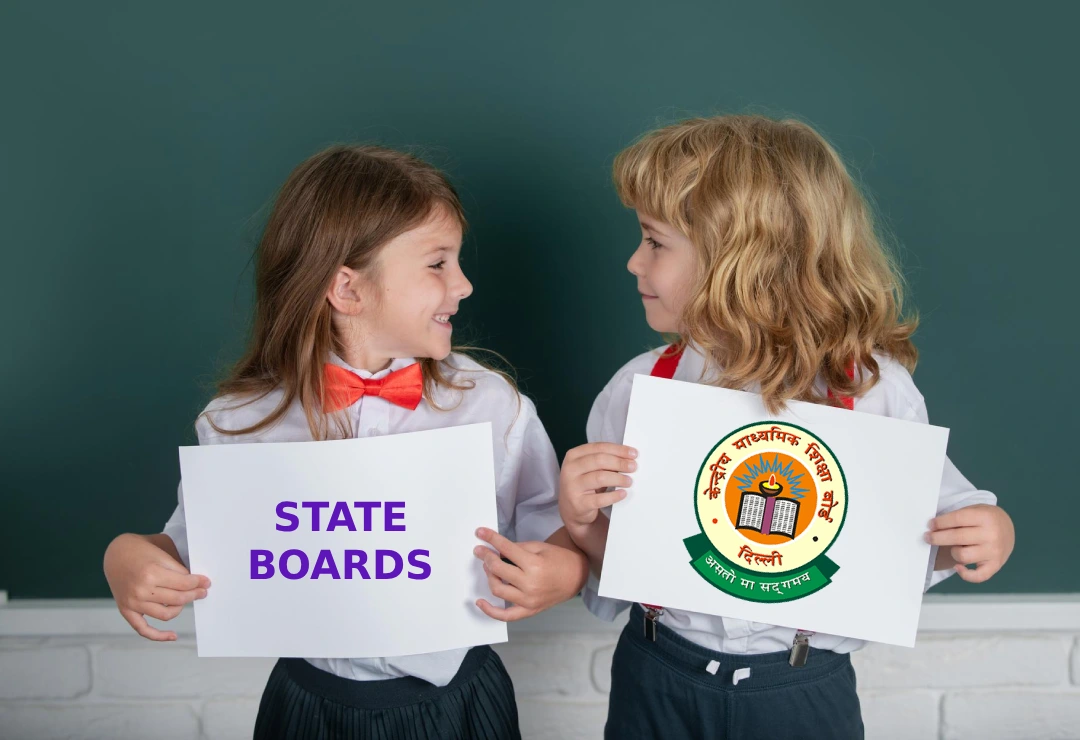
State Board vs CBSE: Complete Difference Guide & Curriculum Comparison 2025
The decision to choose the best educational board for your children is one of the most important decisions that a parent will make. State Board vs CBSE are two of the most debated options. Both systems are designed to meet different learning objectives and have their strengths. However, when planning for a child’s future, many parents wonder which system will provide better opportunities, clarity, and a foundation for the life ahead.
Let’s examine the differences between CBSE and State Board and curriculum structures. We will also discuss student outcomes and long-term benefits.
Understanding the Basics: CBSE and State Board
The Central Board of Secondary Education is a national board that the Government of India manages. It is widely recognised throughout the country and even overseas.The education departments of each state run state boards. Every state has its board. For example, the Maharashtra State Board or the Tamil Nadu State Board.
Curriculum Comparison: Depth vs Breadth
Curriculum comparison is a key point in the State boards vs. CBSE discuss
CBSE:
- Concentrate on conceptual clarity in math and science.
- The course is designed to prepare students for competitive national exams such as NEET, JEE, and UPSC.
- Uses NCERT textbooks that are standardised across India.
State Board:
- Curriculum may include region-specific topics and the state’s language.
- This approach is more memorisation and theoretical.
- The exam is relatively easy in terms of the difficulty level and pattern.
The State Board of Education focuses on balanced learning and regional relevance. While the CBSE curriculum is better suited to competitive exams, it emphasises balanced teaching with a regional focus.
Difference Between CBSE and State Board Teaching Style
The way that subjects are taught is another big difference between CBSE and the State Board.
CBSE schools promote interactive and activity-based teaching. It focuses on reasoning, problem-solving, and foundational understanding.
Depending on the state, many state boards follow a traditional teaching model. This may make it easier for students, but may not fully encourage application-based learning.”
Grading & Assessment
The assessment methods used also vary significantly. CBSE uses a comprehensive and continuous evaluation model. Students are evaluated through class tests and projects. State boards, on the other hand, tend to rely more heavily on final exams, while internal assessment is less important.
This can affect the student’s performance strategy. CBSE students, for example, are more used to receiving regular feedback and evaluations, which can identify any gaps earlier.
Flexibility in Medium and Subjects
State boards are flexible in the language of instruction. Students often study in the regional language they are most familiar with, which is easier to understand. Still, this familiarity can become a challenge when they transition to regional exams or English-medium universities. CBSE is a central board and therefore tends to emphasize Hindi and English as mediums. The standardized format makes it easier to transfer between states or apply to colleges anywhere in the country.
AAS Vidyalaya is a digital platform that helps bridge this gap. It offers access to CBSE and State Board material online, especially for students who live in remote areas or may not be able to attend formal schooling.
The Cost Differences Between Boards
One of the most apparent differences between the State board and the CBSE is the cost. State board schools are usually less expensive because they fit the budgets of families in the area, especially in rural and semi-urban areas.
CBSE schools, on the other hand, often charge higher fees because they have a standardised curriculum, use modern teaching methods, and have better facilities.
Availability and accessibility in different areas
Availability and accessibility in different areas are other significant differences between CBSE and the State Board. State board schools are common and can be found even in remote or rural areas. This makes education more accessible to a broader population.
However, CBSE schools are more common in cities and towns that are only partially urban, which can make it harder for families in smaller towns to find a school.
Different Ways to Train Teachers7. Global Networking Opportunities
The two boards also have very different ways of training teachers. CBSE focuses on structured training programmes that follow national education standards. This makes sure that teachers across the country teach in the same way.
On the other hand, teacher training through state boards varies by state, and in some areas, it may not be consistent or utilise the most current teaching methods.
Needs for Infrastructure
Finally, the infrastructure needs also show the difference between State Board and CBSE schools. For example, CBSE schools usually have to have digital classrooms, science labs, and libraries that meet specific national standards. This makes the learning environment more advanced.
On the other hand, many state board schools, especially those in rural areas, may not have access to many resources and facilities.
Which board helps in competitive exams?
This is where CBSE holds an edge in the State Board vs. CBSE debate.
The CBSE curriculum overlaps with many entrance exams, such as JEE, NEET, and NDA. Most questions on these exams are drawn directly from the NCERT material, so students who have read the NCERT books will often be at an advantage. State Board students do not suffer from this disadvantage. Many of them pass competitive exams, but usually they need extra coaching or other reference materials that are outside their syllabus.
Platforms such as AAS Vidyalaya help bridge the academic gap by offering structured online training aligned to their respective state curriculum.
Higher Education & Recognition
Both CBSE and state board students are eligible to apply for university admissions when it comes to higher education. Certain elite institutions may have a higher level of rigour than CBSE, such as central universities or national entrance exams.
In terms of curriculum comparison, CBSE’s uniform syllabus across India makes it easier for students aiming for institutions with nationwide reach.
State Board students score higher grades due to the lenient grading. Some private colleges will normalize grades during the admissions process to counteract this advantage.
Skill Development & Practical Exposure
In the State Board vs. CBSE debate, skill development and practical exposure are vital. State boards are gradually incorporating skill-based education but still place a high emphasis on theoretical knowledge. They excel at preserving regional language and culture, which is beneficial to students who are aiming for careers as local government officials or regional roles.
The CBSE board has, on the other hand, actively introduced coding and project-based education. This modern, application-driven approach is in line with global standards and offers students better exposure to real-world situations.
Final thoughts: So, which one promises a brighter future?
The distinction between CBSE and state boards lies not only in curriculum structure but also in the goals they serve. If your child plans to take competitive exams such as JEE or NEET, or if they want to move between Indian states, CBSE is often a better option due to its standardised curriculum, national recognition, and alignment with entrance exam patterns.
On the other hand, if your child thrives in a more localised, language-friendly environment or intends to enjoy state-level exams and education, a state board may offer more comfort and accessibility.
Ultimately, the best decision is based on your child’s learning style, career goals, and the school’s ability to provide a quality education, regardless of the board. A nurturing environment, well-trained teachers, and consistent academic support are all required for a prosperous future.
FAQ’s on State Board vs CBSE
1. Which board is better for a child’s future?
Comparing State boards vs. CBSE, CBSE offers a national curriculum that is more standardised, which is ideal for career and mobility opportunities. State boards can be tailored to meet regional goals and preferences.
2. Which curriculum is better for competitive exams?
The CBSE curriculum is closely aligned with the competitive exam patterns for JEE, NEET, and other national-level tests. This gives students an advantage over state board syllabi.
3. Which board provides better skill development opportunities?
In a curriculum comparison, CBSE integrates critical thinking and experiential learning. Most state boards, however, are still catching up on 21st-century skills development.
4. Which board has a more practically oriented curriculum?
In terms of differences between CBSE and State Board, CBSE offers a more practical curriculum with project-based learning and applications-focused subjects as compared to State Boards.